


STEP 01
You review a proposal
We share the property, the plan, the capital required, the return on offer and the expected timeline.
No live deal. Just the introduction that comes before one.
You asked about money partnering with Charlie Property. There's no live deal here, just who we are, how it works, and what to expect when one comes along.
I grew up on a farm, building things with my own hands, including houses made from hay bales. That same energy built Charlie Property.
We don't come from old money. We come from a paddock, hard work, and a belief that anyone can build real wealth through property.
That belief is why more than 30,000 people now follow how we invest and renovate. You bring the capital, we bring the hands-on experience, and together we turn a tired house into something worth being proud of.
There's no live deal attached to this page. Just an honest look at how partnering works, and what it feels like when a real opportunity lands in your inbox.



Most of the people who partner with me fall into a few groups.
Retirees wanting a better return than a term deposit. Business owners with cash sitting idle between their own projects. People with equity who don't want another mortgage. SMSF trustees. Professionals with savings and no time to manage it themselves.
You don't need property experience. I do the buying, the renovating, the selling. You lend the money and collect the return.
A legally binding document between you and me. Every term in writing - amount, rate, timeframe, repayment.
More than 35,000 people follow how we invest and renovate. A partnering conversation with us starts from that same openness, not a cold sales call.
Charles grew up on a farm and learned to build before he learned to invest. Charlie Property grew out of that same hands-on approach, applied to renovation partnerships.
Money partnering is a private lending arrangement. You lend money to a property investor, secured against the property title, and receive a fixed interest return.
Think of it like this. A property operator, like Charlie Property, identifies a house to buy, renovate and sell for a profit. We have the skills, the team and the process, but every project needs capital to fund it. That's where a money partner comes in. You provide the funds, we do the work, and when the property sells, you receive your original capital back plus your return.
People often confuse money partnering with investing in property directly. They're quite different. Here's a clear comparison.
| Buying Yourself | Being a Money Partner |
|---|---|
| Need to get a bank loan | No bank loan required from you; you simply lend what you have |
| Your name goes on the title | Your name stays off the title; you're the lender, not the owner |
| You deal with tenants, vacancies and property managers | No tenants, no property management, no maintenance |
| You cover council rates, insurance and land tax | No ongoing costs; your role ends when the project settles |
| Returns depend on the broader market | Return agreed upfront in the deal terms |
| May take years to see meaningful profit | Typically repaid in months, not years |
| Significant stamp duty and legal costs upfront | No stamp duty; your costs are solicitor fees only |
| Requires ongoing attention and decisions | Simple and hands off; our team manages the project |
Money partners come from all walks of life. The common thread is that they have capital sitting in low-return savings accounts, term deposits, or superannuation - and they want a better return without the complexity of buying property themselves. Typical money partners include:
Retirees and pre-retirees looking for reliable income above bank rates
Business owners with surplus cash seeking a short-term, fixed return
Property owners who have equity or savings but do not want another mortgage
SMSF trustees looking to boost returns within their fund
Professionals with savings who do not have time to manage investments actively
Property operators - sometimes called property flippers or developers - are experienced investors who buy properties with the intention of improving and reselling them. They often prefer private lending over bank finance because it is faster, more flexible, and does not require the same strict criteria as a bank loan.
A professional operator will typically have a track record of completed projects, a team of tradespeople and project managers, and a clear process for renovating and selling. They will present you with a structured proposal outlining the property, the expected sale price, the loan required, and the return they are offering.
Returns in money partnering are quoted as an annual percentage rate (per annum). Because most projects complete in less than a year, your actual return is calculated on a pro-rata basis - meaning it is adjusted to exactly how many days your money is deployed.
Principal × Rate × (Days / 365)
= Interest Earned
Returns are typically accrued daily and paid in full at settlement.
12 MONTHS
$1,000,000 lent
$150,000
6 MONTHS
$1,000,000 lent
$75,000
4 MONTHS
$1,000,000 lent
$50,000
90 DAYS
$1,000,000 lent
$36,986
The rate you are offered will depend on the type of project and the operator's level of experience. Higher rates reflect higher complexity or risk. Always assess the security and the deal structure - not just the headline rate.
Your loan ÷ Expected sale price × 100 = LVR
| Project Type | Typical Rate | Risk Level |
|---|---|---|
| Simple residential renovation (experienced, proven operator) | 12% – 15% p.a | Lower |
| Simple residential renovation (newer or less-established operator) | 18% – 20% p.a. | Low to Moderate |
| Subdivision or small development project | 20% – 25% p.a. | Moderate to Higher |
| Large development with land-only security | 25% – 30% p.a. | Highest |
| Bridging finance (short-term, urgent requirement) | 15% – 22% p.a. | Varies by deal |
Figures illustrate typical market ranges for context, not a Charlie Property offer. Every real proposal states its own specific rate and terms.
This is the most important question to ask - and the good news is that money partnering, done correctly, has built-in legal protections that most other investments simply do not offer. Your protection is not based on trust or goodwill - it is based on legally registered documents and enforceable rights.
Your solicitor registers a legal security - either a mortgage or a caveat - on the property's certificate of title through your state's land titles office. This registration appears on the public record and means:
The property cannot be sold without your registered security being discharged
The property cannot be refinanced without your knowledge and consent
You must be paid out before any sale proceeds flow to the operator
Anyone searching the title can see that you have a legal interest in the property
A registered mortgage is the strongest form of security - it gives you a direct power of sale if the borrower defaults. A caveat is a formal notice of your interest and prevents the property being transferred or refinanced without your consent, though it does not carry an automatic power of sale on its own. Both are meaningful and enforceable.
The loan agreement is a legally binding contract — drafted or reviewed by a solicitor — that sets out every aspect of your lending arrangement. It covers:
The identities of both parties — you as lender, and the operator (or their company) as borrower
The exact amount being lent
The interest rate and how it is calculated (daily accrual is most common)
The repayment date — usually linked to settlement of the property
What constitutes a default — such as missed payments, selling without consent, or insolvency
What you are entitled to do in the event of default — including the right to enforce the security
Details of the registered security on the title
Who pays legal costs if enforcement is required
Without a solid loan agreement, your registered title security becomes much harder to enforce. The agreement is what tells a court — or a conveyancer at settlement — exactly what you are owed and what was agreed.
Most property operators borrow through a company for tax and legal reasons. However, this can create a risk: if the company runs out of money or becomes insolvent, you could find yourself as just another creditor waiting in a queue.
A personal guarantee removes this risk. It is a document signed by the director or directors of the borrowing company, in which they personally commit to repaying you if the company cannot. This means:
You are not limited to recovering your money from the company alone
You can pursue the individual — their personal assets, savings, and property
The guarantee typically includes an indemnity for your legal costs if enforcement is required
What to Check
A personal guarantee is only valuable if the person signing it actually has assets. Before lending, ask who the directors are and satisfy yourself that they have a meaningful personal financial position. A guarantee from a person with no assets is of limited practical value.
LVR stands for Loan-to-Value Ratio. It is one of the most important metrics in any secured lending arrangement. It tells you how much of the property's expected sale value is covered by your loan. The lower the LVR, the more buffer you have if the property sells for less than expected.
Formula: Your Loan Amount ÷ Property's Expected Sale Value × 100 = LVR
Your loan
$100,000
Property expected to sell for
$650,000
LVR
15%(extremely conservative)
Your loan
$300,000
Property expected to sell for
$650,000
LVR
46% - comfortable buffer
Your loan
$480,000
Property expected to sell for
$600,000
LVR
80% - less buffer
General guidance
Aim for an LVR below 70% for residential renovations, and below 60% for more complex projects.
No investment is without risk, and it is important to understand what happens in a worst-case scenario. If the property operator cannot repay you by the agreed date, you still have rights - because your legal security is tied to the property itself.
Depending on the deal, your solicitor can:
Issue a formal demand for repayment under the loan agreement
Exercise mortgagee rights - taking steps to have the property sold to recover your funds (if you hold a mortgage)
Enforce your caveat - preventing any sale or refinance from proceeding without you being paid
Pursue the personal guarantee against the director
Take legal proceedings if required
The key protection here is that the LVR must be conservative enough that even a lower-than-expected sale price still covers your loan in full. This is why a buffer below 70–80% is so important
STEP 01
You review a proposal
We share the property, the plan, the capital required, the return on offer and the expected timeline.
STEP 02
You do your homework
You check comparable sales, review our track record, and confirm the LVR sits within a buffer you're comfortable with.
STEP 03
You engage your own solicitor
Non negotiable. Your solicitor, not ours, reviews the agreement and conducts a title search.
STEP 04
Legal documents are finalised
The loan agreement and personal guarantee are signed, and a funds direction notice is prepared.
STEP 05
Your security is registered
The mortgage or caveat is registered on title before any funds are released.
STEP 06
Funds are transferred
Capital moves to the solicitor's trust account or as specified in the agreement. The project begins.
STEP 07
We renovate and prepare for sale
Our team manages the renovation and gets the property market ready, with updates along the way.
STEP 08
The property sells
At settlement, the conveyancer distributes proceeds according to the funds direction notice, you first.
STEP 09
You're repaid, security discharged
Your capital plus return lands in your account, and the mortgage or caveat is formally removed from title.
Project Type
Typical Duration
Notes
Simple residential renovation
4 – 6 months
The most common and fastest type of deal
Renovation requiring council approval
6 – 9 months
DA process adds time
Subdivision into 2 lots
9 – 14 months
Council and title process adds complexity
Small development (townhouses)
12 – 18 months
Construction and settlement timelines vary
Bridging finance
1 – 4 months
Short-term by design - operator has a clear exit
| Walk away if |
|---|
 Deal finder is vague about where the money will go or refuses to provide a Funds Direction Notice |
 They discourage you from getting independent legal advice |
Projected returns seem unusually high with no clear explanation |
They cannot explain what happens if the deal goes wrong |
Reluctant to provide references from previous money partners |
Wants funds transferred to a personal account (not trust or solicitor account) |
Pressure to decide quickly — 'the deal is about to close' |
| Charlie Property's standard |
|---|
 Claims to have funds but cannot provide proof in a reasonable timeframe |
Hints that the funds are borrowed from another source (chain of debt) |
Wants to be actively involved in managing the property beyond their role as lender |
Seeking equity in the property rather than a lending arrangement |
Pattern of disputes or legal action from previous investments |
Cannot confirm whether funds are from SMSF, personal savings, or another source |
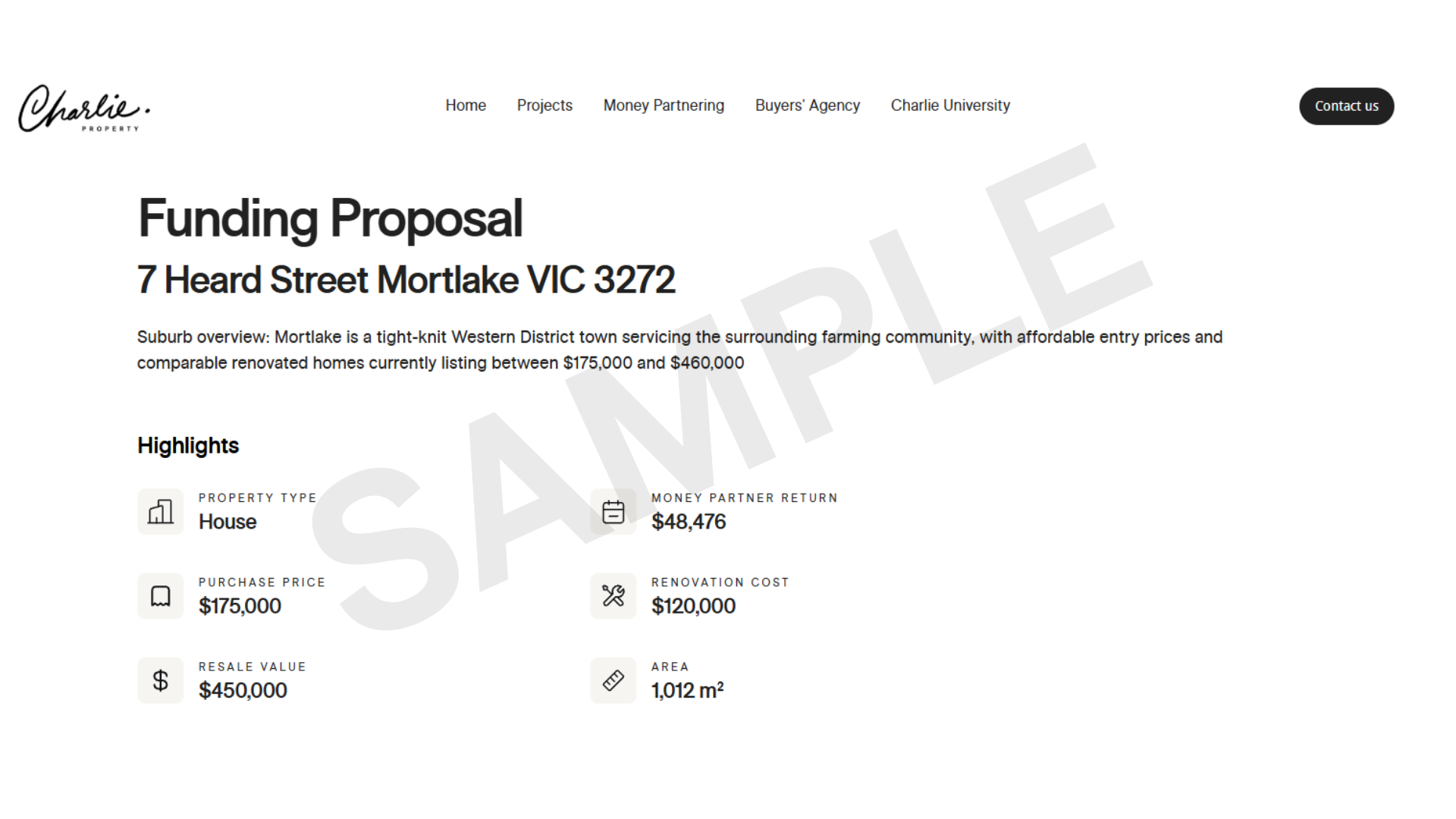
When we bring you an actual opportunity, it's structured like this. Everything below is illustrative, styled on a real property snapshot, not a live deal.
No. You don't need to own property or have experience in real estate. You're acting as the lender, not the buyer. Charlie Property handles all purchasing, renovation work, project management and selling. Your role is simply to provide the capital.
It varies by deal. Some projects raise capital from a single money partner, others are split between several. We'll always confirm the amount sought before you commit to anything.
In some cases, SMSF trustees can lend through their fund. This depends on your fund's trust deed and your own financial advice; we'd recommend speaking with your accountant or financial adviser first.
Generally yes, interest earned is assessable income. We'd always suggest getting your own tax advice on how it applies in your situation.
Timelines can shift with any property project. A well structured agreement sets out what happens if a sale takes longer than expected, and your security stays in place until you're repaid in full.
Yes, some of our money partners fund more than one deal at once, once they're comfortable with how the process works.
No. There's no standing commitment. Each deal we bring you is its own decision, made on its own terms.
Regardless of how you are introduced to a deal, always verify the operator's track record independently — look for evidence of past completed projects, ask for references from previous investors, and check that they have an appropriate level of experience for the type of project they are proposing.
Join our money partner opportunities group below. That's where we post first.
Before committing to any money partnering deal, work through every item below. If you can't tick every box, it's worth pausing until you can.When we bring you an actual opportunity, it's structured like this. Everything below is illustrative, styled on a real property snapshot, not a live deal.

I have engaged my own independent solicitor (not the operator's) )
My solicitor has reviewed the full loan agreement and I understand all terms
My solicitor has conducted a full title search and confirmed the property's ownership status
A mortgage or caveat will be registered on the property title before I transfer any funds
I have verified the expected sale price using comparable sales in the same area
A mortgage or caveat will be registered on the property title before I transfer any funds
I have received and reviewed a Funds Direction Notice - I will be paid at settlement, not afterwards
I have received a personal guarantee from the director(s) of the borrowing entity
I have seen evidence of the operator's past completed projects - not just promises
I have spoken to at least one independent reference from a previous investor
I understand exactly when I expect to be repaid and what happens if it is delayed
I am comfortable having this money tied up for the full project term without access
I have obtained tax advice on how the interest income will be treated in my hands
I have not been pressured or rushed into this decision
I have only lent an amount I can genuinely afford to have at risk
We post new opportunities to our money partner WhatsApp group before anywhere else.
Join to get a first look when the next deal is ready.





We’ve always been the ones who see things as they could be, not as they are, the ones who step outside the crowd and back what others overlook.
Our strategy is simple but unique: we buy properties off market and under value, renovate them, and create clear profit through flips or flip-holds.
While there’s strong demand to partner on our projects, we keep it selective to ensure the right fit both ways.
And beyond the houses and the money, what really matters is building a strong network of like-minded people - a family, in property.
© All rights reserved 2026 charlieproperty.
